It is obvious to me that Brandeis seeks to destroy Modernism on its campus. In architecture there is the so-called “50 year rule” which says that after 50 years a building will be harshly criticized as unsightly, a monstrosity, etc. Considering that many of Brandeis’ buildings were constructed in the 1950s during what is called the Modernist era, we’re starting to hit the 50 year mark where people strongly dislike the styles of Brandeis’ buildings. Take a look at this map of campus, complete with dates of construction:

I think you’ll find the rule to hold true with your personal preferences. You strongly dislike Massell Quad (1952), Sherman Hall (1959), Goldfarb Library (1965), Rabb Quad (1961) and the oldest parts of the Science Center (1956-1958). However, Usen Castle (1928), the oldest building on campus, is beautiful, and Farber Library (1984), the Mailman House (1972), and Ziv Quad (1980s) aren’t so bad. For me, the 50 Year Rule is a very interesting concept that says a lot about human nature. We like the things from the years around our grandparents’ birth, hate the things from the years around our parents’ birth, and aren’t sure about the things from around the years of our birth.
Nowhere have I seen the 50 Year Rule more clearly expressed on Brandeis Campus than in the Olin-Sang American Civilization Center. One day I arrived at my politics discussion section on the second floor a few minutes early. After I sat down I noticed that one of the ceiling tiles was missing, so I got up and checked it out. I saw the well-known waffle-block ceiling found across campus, but that wasn’t all. To my amazement, I viewed through the hole a beautiful arched frosted glass skylight, the light shining through.
Modernism Revealed
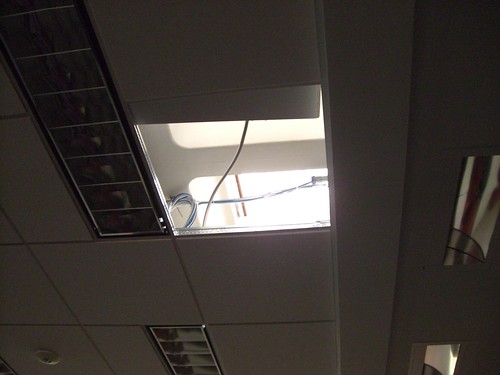
The Light Shines Through
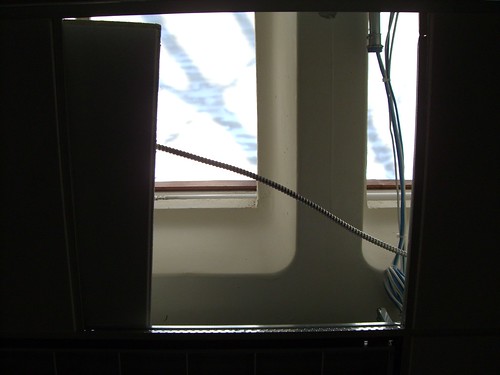
Normally I don’t find connections between my love for Brandeis, architecture, and progressivism, but in this case I do. Progressives don’t believe in erasing the past, we believe in embracing it and fitting it to meet today’s and tomorrow’s needs. Our university sought to hide elements of Modernism, ironically in the effort to modernize classrooms with new lighting, carpet, and “normal” ceilings. Even though progressives may not like the America of the 1950s, that doesn’t mean we see history in black and white, right and wrong, modern and old-fashioned.