Judge Rotenberg Center Update: What You Can Do Now

[Please extend a warm welcome to my good friend Liza. -Sahar]

Children continue to be tortured in Massachusetts. For those of you who haven’t had the pleasure of Brandeis Students Against the Judge Rotenberg Center visiting your dorm room, the JRC is a school in Canton for people with mental disabilities. Students here are hooked to electronic devices at all times and given painful two-second skin shocks as a way of behaviorist conditioning, for infractions as small as speaking out of turn or falling asleep in class. Aversive treatment is not only inhumane, it is ineffective: students revert to former behavior once negative stimuli are removed. A statewide campaign of psychologists and disability rights activists has worked to stop this cruelty for decades.

Here’s a brief update on the efforts in the State House and at Brandeis to shut it down.

Senator Brian Joyce, a disability rights advocate who co-authored anti-JRC legislation currently in study (a.k.a. not going anywhere), put an amendment in the state budget that would regulate, but not ban, aversive shock treatment. Amendment EHS 874 is essentially the same as the “compromise” bill, S 1123, with one key difference: it permits the use of shocks for minor behaviors, only if all other forms of treatment are proven to not work. Therefore this legislation is far from perfect, but would still add a crucial level of psychologist oversight. You can read it here: http://www.mass.gov/legis/09budget/senate/amendments/ehs2.htm

The conference committee is running behind schedule, and will decide by the end of July whether or not this amendment will go to the House floor. It already passed in the Senate, a significant half-way victory. Please take a second to call Representative DeLeo, chair of the Ways and Means Committee, asking him to take action against cruelty to the disabled. Here is an optional script:

Representative Robert DeLeo: 617-722-2990

“Hello, my name is_________ and I’m from Brandeis University. I am calling to urge Representative DeLeo to support Budget Amendment EHS 874, restricting the use of cruel aversive treatment. The electric shocks used at the Judge Rotenberg Center are inhumane and unsafe, as demonstrated by the recent prank incident in which a student was wrongly shocked 77 times in three hours. This amendment offers a reasonable compromise, allowing aversive treatment in extreme cases but preventing future disasters. Please support disability rights in Massachusetts. Thank you.”

Here is another reason why Rep. DeLeo is important to this issue. While lobbying at the State House, David Emer and I had the pleasure of meeting with Representative Barbara L’Italien, a leading anti-JRC figure in the State House. She insisted that little progress can be made on this issue as long as Salvatore DiMasi remains the Speaker of the House. He is a close ally of Representative Jeffrey Sanchez, whose nephew is actually a JRC student (fyi: This was a hit at the January hearing in which Sanchez’s brother screamed, “I do not have a son: I have a retarded boy,” among other abhorrent statements). However, Representative DeLeo is a top contender to be the next Speaker. Therefore, even if legislation does not pass this time, our calls to DeLeo are still crucial to the future of disability rights.

For more information about JRC, read this Mother Jones article: http://www.motherjones.com/news/feature/2007/09/school_of_shock.html

or this Boston Globe article describing a single telling incident: http://www.boston.com/news/education/k_12/articles/2007/12/18/prank_led_school_to_treat_two_with_shock/
Fear

As a society, we’re very afraid, aren’t we? If you listen to our “leaders” (since when did elected representatives turn into leaders, I wonder), we should be cowering in our beds.

Fear of Gays, fear of Blacks, fear of Browns, fear of Athiests, fear of Arabs, fear of terrorists, fear of immigrants, fear of inner cities, fear of drugs, fear of the future, fear of “the other”.

Fear of the poor has replaced compassion for the poor.

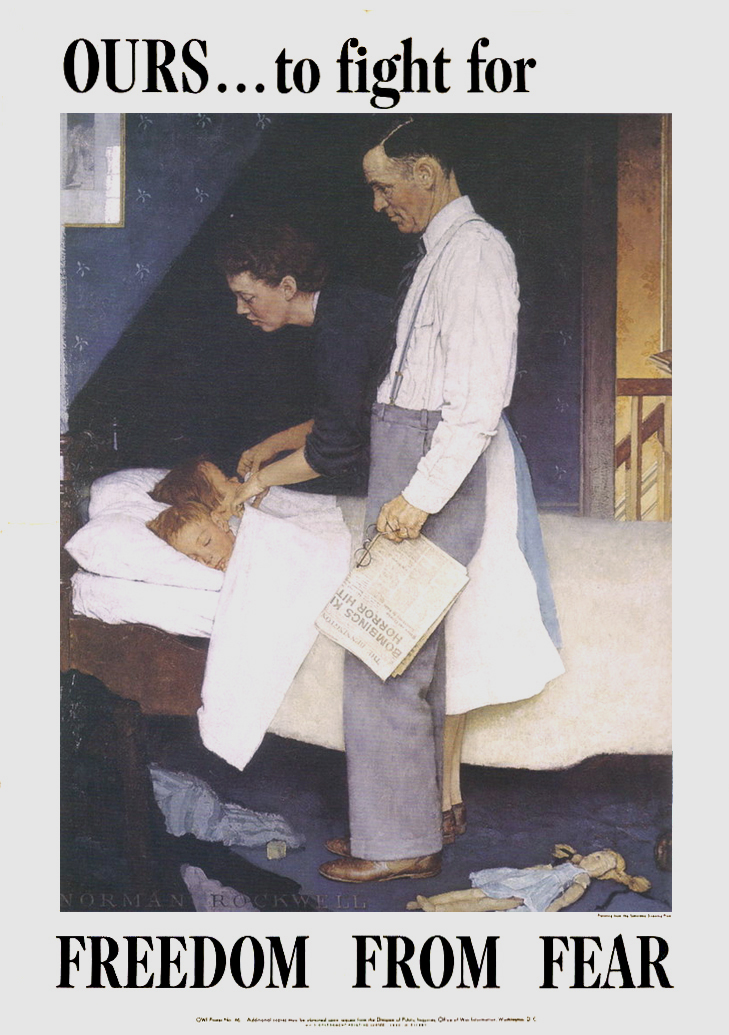
Progressives believe in freedoms. Like, for example, freedom from fear:
Freedom from Fear, by Norman Rockwell

Thoughts on Libertarians at 5 am

The “civil libertarian” and “liberal” views on rights, the NSA, PATRIOT act, etc, are identical.

Same with economic libertarians and “conservatives”. (They call themselves conservatives, but they’re actually reactionaries – they want to drag the US back to the Coolidge / Harding days, rather than real conservatives, who instead simply want to consolidate and improve what we’ve got)

Economically, what distinguishes libertarians from right-wing fat cats? And why are libertarians so obsessed with “freedom from government” rather than freedom from corporate power?

When I talk to libertarians, they often trot out anecdotes about zoning laws, licensing laws for florists, etc for examples of government abusing its power to help firms seek rent. This is petty-bourgeois territory. Liberals are against that too. Where libertarians and liberals break is not over obvious/basic examples of corruption, but rather on the big stuff. Social Security. Single Payer Health Care.

I’d argue that Social Security is a proven success story and Universal Health Care is not only a moral issue but pretty strikingly better policy than what we have now.

Of course that’s a rather broad generalization of a diverse economic philosophy. I was just thinking to myself, though. Libertarians who embrace sane economic policy are pretty much liberals.

That’s not to say we can’t work together, though. I have a lot of respect for people so passionate about defending against the Imperial State. Two fists in the face of Empire! Right on.

Best Served Cold

He is wrapped in an enormous coat, way too thick for the sweltering heat. Then again, that coat will serve him well in the wintry months; how else can he carry it until then? If he had a house to store his coat in, he wouldn’t need be here, after all, with his back to the steel and coffee / spit-and-polish of a Starbucks.

If he had a house in which to store his coat, he wouldn’t be hunched over a trash can, peering quizzically at a paper and grease time capsule from hours ago. Throw out the ketchup packet, and success! A small victory over the garbageman. Curly fries served cold, an artifact of a lifestyle different but not too far-off from his own. (For after all, he’ll never excavate grey poupon over swordfish from these ruins.)

Continue reading “Best Served Cold”

Unite for Change

Yesterday, volunteers for Barack Obama’s presidential campaign held over 4,000 Unite for Change events across the country to lay the groundwork for the campaign ahead.  This emphasis of community organizing has become par for the course for the Obama campaign and stands out as one of the hallmarks of Obama’s entire career.  Focusing on grassroots development will not only help Obama win in November but will pay dividends for Democrats in down-ticket races across the country and will build the party’s base in a way that will pay off for years to come.

I attended the Ansonia for Obama event, and I was very pleased to see a lot of enthusiasm from the supporters I met.  Ansonia, Connecticut is a small city of approximately 20,000 people bordering my hometown of Seymour.  Like Seymour, it’s located in the region known as “the Valley”, a working class industrial area significantly poorer than the upper class Amity region to the immediate east.   As the factories leave, Ansonia has been unusually successful at revitalizing its downtown with small businesses, particularly antique stores.  Politically, Ansonia is influenced by nearby New Haven. a hotbed of progressive activism in the state.  Democrats outnumber Republicans by about 2.5-to-1.  However, this support has not historically translated to the national party.  In 2004, John Kerry only defeated George Bush by a margin of about 4,000-3,200, and the Democratic primary turnout of 47% was among the lowest rates in Connecticut (Hillary Clinton won the city by almost a 2-to-1 margin).

Only four other people were at the meeting; however, despite the low turnout, we were able to lay plans for action that could pay big dividends come November.  Most of the discussion centered around getting visibility in the local media and setting up voter registration drives at community events.  We hope to particularly focus our registration efforts on Ansonia’s substantial, largely poor African-American population, a group suffering from very low turnout rates and a lack of attention from area politicians.  Ansonia is exactly the type of city in which a strong voter outreach effort could provide incredible results.  If we can unify the party and reach out to the disenfranchised, the demographics are such that we could capture a huge groundswell of support for Obama.

I strongly encourage everyone to seek out their local Barack Obama groups and find out how you can get involved with the campaign.  These local efforts make a huge cumulative difference.  If you can’t find a group, then start your own; Ansonia for Obama is living proof that you don’t need many people at this se of the game to set the framework for an election season of effective activism.

Hyperconnectivity

As Sahar mentioned, he and I just attended the Personal Democracy Forum, a conference devoted to examining how the latest technology will impact politics and how the internet’s power can be harnessed to further one’s political cause. The main lesson I learned can be distilled into one simple sentence: the internet is a very powerful tool.

Now this is common knowledge; you would need to have been a complete hermit for the past ten years not to recognize the incredible extent to which the internet has revolutionized every aspect of our lives. So let me rephrase that statement give you a better sense of exactly what I now understand: the internet is a very, VERY power tool.

As in, so powerful that the revolution it has brought so far is child’s play compared to what the next few years will bring.

As in, so powerful that even if you think you already knew this, you still have absolutely no idea how vast the shift in politics will be. I doubt that anyone really does.

Needless to say, there’s a lot more to this idea than just that, and over my next few posts, I’m going to explore some of the ways the internet can be applied to further political and governmental goals, not only on a national scale but also at Brandeis and through Innermost Parts. The conference provided much food for thought, and I hope to apply some of the ideas presented there to improve the way in which our site functions. The speakers were excellent; highlights included Arianna Huffington’s smackdown of corporate media, former John Edwards blogger Tracy Russo’s searing condemnation of John McCain’s technological naivety, and Jonathan Zittrain and Mark Pesce’s insightful commentaries on the possible dangers of internet politics.

The moment that best summed up the entire conference, however, came courtesy of Elizabeth Edwards. It wasn’t in anything she said (though I was pleased to hear that Obama offered to make her a large part of his health care team). It was how she said it, or more accurately, the way in which she addressed the audience.  Edwards was supposed to have attended the conference in person, but stormy weather in North Carolina prevented her plane from taking off.  As little as five years ago, this might have made it impossible for her to address the group; however, due to the wonder of Skype, we were able to see and hear Mrs. Edwards from her home in Chapel Hill.  The technical problems were minimal and easily solved, and we even got a cameo appearance from John Edwards as he returned home.

More than anything else, this demonstrated the reality and potential of hyperconnectivity, the developing state of interaction in which all people can be instantly connected to each other or to any piece of public information at the click of a button.  This is a revolution beyond any in human history since the birth of long distance communication, and its applications will be monumental in every facet of our lives.  Those of us in college right now are the lucky ones given a front row seat to this transformation, and while certain aspects of it may be daunting, I can’t help but feel anything but excitement.  We are entering an era in which every significant problem humanity faces will be solvable, and while there’s no guarantee that we will actually take the steps necessary to solve them, we can rest assured that the information needed to discover who exactly is holding us back will be more and more readily available.  So specifics and cautions will come later, but for now, take a moment to think about the paradigm shift to come and to marvel at a future where anything is still possible.

Happy Mixed Race Day!

At least, to all you Brazilians out there. June 27th is Mixed Race Day, a holiday celebrated in Brazil, perhaps the most racially diverse nation in the world. More info (unfortunately in choppy English) from the Brazilian Multiethnic Movement:

The date, June 27, is a reference to the twenty-seven mixed-race (“mestiço”, in Portuguese) representatives elect during the 1st Conference for the Promotion of Racial Equality, occurred in the City of Manaus, State of Amazon, Brazil, from April 7 to 9, 2005, and also to the month of June, in which a mixed-race woman, after systematic opposition from anti-multiracial Black groups, was registered as the only Multiracial representative in the 1st National Conference for the Promotion of Racial Equality, occurred in Brasilia, from June 30 to July 2, 2005, promoted by Government of Brazil. The Mixed-Race Day (“Dia do Mestiço”, in Portuguese) was made a official date of the City of Manaus on January 6, 2006. On March 21, 2006, in the International Day for the Elimination of Racial Discrimination, the Mixed-Race Day became an official date of the State of Amazon; on October 6, 2006, of the City of Boa Vista, in the State of Roraima and on October 9, 2007, became an official date of this State. The Mixed-Race Day pays homage all those who possess multiracial or multiethnic origin. It occurs three days after the Day of the Caboclo, the first mixed-race Brazilian.

Even though we don’t officially celebrate it in any way, this year’s Mixed Race Day is particularly important for us in the United States. For the first time in our nation’s history, a man born from parents of two different recognized ethnic groups (according to our US Census) is the front-runner to become our next president. Regardless of one’s politics, everyone should recognize that this represents the progress we’ve made on racial issues from the days when such an individual would be widely referred to as a “half-breed” or a product of “miscegenation” or “amalgamation”. If that’s not convincing enough, consider that when Barack Obama was born, his parents would not have been allowed to marry legally in several states; it wasn’t until 1967’s Supreme Court Case Loving v. Virginia that the final anti-miscegenation laws were overturned.

I strongly encourage any Brandeis student of a mixed racial background or who is interested in issues surrounding mixed heries to check out Brandeis’s Mixed Herie Club (disclosure: I’m the treasurer of the MHC).

The Death Penalty

Time to send some kudos over to my former blogmate.  Alex Norris has a very insightful piece up at Upon the Gears about the backlash against the Supreme Court’s recent ruling that executing child rapists is unconstitutional.

The decision, reached by a narrow 5-4 majority, ruled that execution was not a proportional response for rape and so violated the cruel and unusual punishment prohibition of the eighth amendment.  Naturally, government officials were infuriated by the idea that they would no longer be allowed kill people.  Amateur exorcist and faith healer Bobby Jindal vowed that authorities in his state would “evaluate ways to amend our statute to maintain death as a penalty for this horrific crime”, leaving no doubt to his complete commitment to undermine our nation’s highest court (between demon expulsions, Jindal moonlights as the governor of Louisiana and potential running mate for John McCain).  Even the deep partisan divides of presidential politics can be overcome when some killin’ needs to be done, as CNN reports:

Republican Sen. John McCain called the ruling “an assault on law enforcement’s efforts to punish these heinous felons for the most despicable crime.” Democratic Sen. Barack Obama said there should be no blanket prohibition of the death penalty for the rape of children if states want to apply it in those cases.

So are our elected officials nothing more a pack of bloodthirsty vigilantes, Alex?

The short answer: no. Our lawmakers are no thirstier for death than we are, as I realized when I thought for a moment. They are thirstier for something that is much more to their benefit. I’m talking, of course, about votes. Everyone wants to be popular. Sometimes, an easy way to make yourself popular is to play the role of a defender of justice and children. How does one cultivate this role? Killing people nobody likes.

I completely understand how sick and disgusting the crime of rape is, and I am horrified at the thought of a child having to suffer from it.  Anyone who would assault a child in this way deserves a very lengthy prison sentence and psychiatric counseling.  But the death penalty is the most counterintuitive solution to violent crime that I could imagine.  We’re going to prove our objection to murder by killing?  We’re going to demand all of our elected officials use the state to continue the cycle of violence?  The only reason capital punishment exists is to satisfy our desire for vengeance, an irrational relic of our primitive past.

I think we all can agree that it takes a warped, sickened mind to commit sexual violence against a child.  But how do our progressive values support killing a criminal because of their mental illness?  Yes, we need harsh prison sentences for these predators to dissuade copycat crimes.  Yes, we must ensure that anyone whose mental problems are so great that we cannot prove medically beyond any doubt that they are no longer a threat to children will never be released from psychiatric confinement.  But we must never forget that despite their heinous actions, even the most disturbed criminals are still human and are victims themselves.  And while the illness that victimizes them may in some cases be so great that they cannot function in normal society, that does not preclude their humanity and the chance that, through prison work programs and similar institutions, they can eventually redeem themselves as contributing members of society.

It takes no strength for a politician to support the execution of a rapist; it merely takes a good ear for public sentiment.  The true strength of character comes from those politicians who can overcome the visceral reaction to the most heinous crimes and the overwhelming public opinion and still find a way to advocate for the rights of the guilty, the most reviled and powerless in our society.

We have to look past our rage at these people and think about what this is doing to our humanity as a nation and as individuals. If we consider the difference between life in prison without parole and a death sentence, which one can we be prouder of? What if, as a nation, we could say “The United States of America does not kill.” [sic] That would be a day that all patriots could take pride in.

The Slip

John Edwards (on Skype!) – “I think the internet has totally changed the course of this campaign. For instance, barack Obama would not be taking public financing if it werent’ for the internet and small donors and so forth … it allows him to have the money to take on George Bush.  (pause) oh sorry I mean John McCain”

A talk with Elizabeth Edwards

We’re talking to Elizabeth Edwards on skype.

Talked to the guy who does web stuff for the Sarkozy gov’t and the guy who does web stuff for the Gordon Brown gov’t. This is like woah. There are only like 6 of these people who take charge of web outreach for western democracies in the world, and two of them met in person. Interesting to see them interact.

Some talk about using the power of the web with gov’t to solve problems easily. Example – if you submit your taxes online, the gov’t could, for example, ask you if you want to register to vote, or tell you if you’re eligible for food stamps when you’re done.

Imagine after you go to the doctor, he gives you the contact info of a bunch of local people with the same disease. Easy to implement, wide-ranging effects.

Elzabeth Edwards – campaigns really mostly view the internet as a spigot for money.

Campaign Blogging: Learning from the Pros

Edwards Internet guy agrees: “The Obama campaign blog is *AMAZING* . The way they connect with people and let their personal stories shine through.. I wish I had the skill to do that”

Obama campaign claims that there isn’t a coherent strategy to be standoffish to the blogs.

Gist of a Quote: “the Bush Campaign in 2004 had great success organizing people over the internet.”
I find this argument credible.

wisdom: campaign internet tools have two facets – highly targetted messaging etc, and tools to allow people to organize online for offline action.

At the Personal Democracy Forum

Adam and I are at the Personal Democracy forum, which is a fancy-pants convention (700$ entry free) about the intersection between politics and tecnology.(I hooked us up with a volunteer scholarship)

There have been many interesting speakers and so forth: I’ll try to pass on whatever cool info I learn.

Cool things so far – I’m sitting right next to Ben Smith right now. Adam checked in Matt Stoller. I found Lawrence Lessig!

Wisdom : “Imagine a world where Linux Torvalds had to lobby Microsoft for a better/open operating system. Imagine a world where Jimbo Wales had to se protests outside brittanica headquarters, demanding they free up their information. Community activists can take things into their own hands”

Three Initiatives on Mass. Ballot in 2008

On November 4th, Massachusetts voters will be choosing more than just a President (and a Senator, and a slew of state and local officers). As one of 24 states with provisions for public initiatives, Massachusetts allows all of its citizens to act as lawmakers, and the AP reports (via Blue Mass. Group) that three separate questions appear to have qualified to go before the voters in 2008. To make the ballot, an initiative needs 11,099 signatures from registered Massachusetts voters; once it qualifies, it only requires a majority of votes cast to pass. The catch is that it does not pass as a new law but only as an official instruction to the legislature compelling them to vote in a certain way. I imagine that the legislature feels strong political pressure to follow the wishes of their constituents when expressed in such an official manner. However, I’m not sure what the actual record of successful initiatives being turned into law is, and regardless, it seems like an awfully shifty way to give citizens the guise of empowerment while withholding any actual authority from the public. (Edit — Upon further review of Massachusetts election law, this isn’t actually the case. If the measure gets the majority of the votes, it automatically becomes law, provided its supporters amount to more than 30% of the total number of voters.)

So what are these initiatives, and are any of them good ideas?

The first would end the Massachusetts income tax, and while the siren call of fewer taxes makes this one look tempting, I think it would be an unreservedly bad idea. The initiative would not lower taxes in any way, and lawmakers would assuredly just find a different source of income to replace it. One option would be to dramatically increase the property tax. BMG commenter MichaelBate outlines two reasons why this would be a bad idea:

1. Property taxes are highly regressive. The value of someone’s property is very poorly related to ability to pay, especially for retirees who may have a nice home but not much else, including no job and not much income.

2. Taxing property creates an incentive for overdevelopment… City and town officials are forever trying to increase the tax base, leading to more and more sprawl and ever higher density of buildings.

Making seniors homeless and promoting urban sprawl are not OK in my book. The other option would be to raise the sales tax, which would have even more regressive results. Cost of living expenses, already increasing with the slow economy, would become even more stifling for the poor, as necessities like food, clothing and gasoline become more expensive. If that’s not convincing enough, you just need to be a little more self-interested; a higher sales tax would impact college students. We’re a low-income group, and I know I don’t have the spare change to shoulder a tax burden that would be lifted mainly from the wealthy. Governor Deval Patrick publicly called out the elimination of the income tax as “a dumb idea”, and I have to agree with him. Income tax reform is always a good discussion to have, and I’m not saying Massachusetts’s current tax structure and rate are perfect (I honestly have no idea), but the income tax is the best vehicle for progressive taxation, and repealing it could be an economic disaster for the working class.

The second initiative would ban greyhound racing in Massachusetts. Animal cruelty is always inexcusable, and under the conditions that racing dogs currently suffer through, greyhound racing amounts to nothing more than legalized torture. The Committee to Protect Dogs, the group behind this initiative, has the facts:

  • The dogs are kept in cages barely large enough to allow movement for over twenty hours a day.
  • They face incredibly high rates of injury — over 800 over the past six years in just the two operating racetracks in Massachusetts.
  • The kennels are hotbeds of disease, and the dogs are fed raw meat deemed unfit for human consumption.
  • In one disturbing (and admittedly somewhat amusing) incident, several years ago a dog at Wonderland Greyhound Park twice tested positive for cocaine (why were they giving the dogs coke tests in the first place?!?!).

Eight years ago, a similar initiative was defeated by a narrow 47%-48% tally, and I strongly hope that this one gets the last few points necessary for passage.

The third initiative would decriminalize possession of less than an ounce of marijuana. Jailing people for victimless crimes like smoking a joint wastes government money and ruins the lives of blameless individuals. Marijuana is not chemically addictive, has much milder long term effects than alcohol or tobacco, provides medically proven health benefits, and cannot lead to overdose. You don’t need to agree with marijuana use to see that the taxpayer expense for prosecuting these “crimes” is completely unnecessary.

In the United States, the ballot initiative has shown itself to be a powerful tool for political action both negative (numerous same-sex marriage bans) and positive (all six states proposing minimum wage increases passed them in 2006). However, empowering the citizen is always a good thing, and I hope Massachusetts’s initiative laws are strengthened in the coming years. In the short term, all Massachusetts voters have a chance to make their voices heard on three key ideas (two good, one bad IMHO), and I encourage everyone to educate themselves and make informed choices on these issues as well as on the candidates on Election Day.

Congratulations, Sahar!

Democracy for America, the political action committee founded by Howard Dean following his 2004 campaign for president, recently held a competition to award scholarships to deserving progressive bloggers to attend Netroots Nation, the leading political convention for online progressive political activists.  Prospective attendees submitted biographical profiles to the DFA website, and visitors to the site were able to vote on the applicant they felt most deserving.

The results are in, and I’m thrilled to announce that InnermostParts will be well represented at Netroots Nation in the person of our co-founder, Sahar Massachi.  Sahar has earned front page recognition at Blue Mass. Group, Massachusetts leading progressive blog, and the right to rub elbows with luminaries of the progressive movement like DailyKos’s Markos Moulitsas Zuniga and MyDD’s Jerome Armstrong.

Take a look at Sahar’s application, and you’ll see how deserving of the honor he is.  As a sophomore in college, his resume already includes a Academy Fellowship at the Roosevelt Institution and the directorship of the National Committee for the Draft Lawrence Lessig movement.  Anyone familiar with Innermost Parts’s history knows the dedication Sahar has put into making this site function and grow and the breadth and acuity of his political knowledge.  I’m honored to continue working with him to expand the progressive movement at Brandeis and beyond, and I heartily congratulate him on this achievement.

Critical Comment About Abuse of Power

Saw this on DailyKos, thought it was important to repost:

As I’ve written before, Democrats will regret embracing the expansion of executive power because a President Obama will find his administration undone by an “abuse of power” scandal. All of those powers which were necessary to prevent the instant destruction of the country will instantly become impeachable offenses. If you can’t imagine how such a pivot can take place then you haven’t been paying attention.

This is why I wish Hoyer had the balls to stand up to the President.

The Great Flood

For the record? Global Warming is projected to cause exactly the sort of flooding we’re seeing now in the Midwest.

The British and the Chinese understand global warming has driven their record flooding. The United States? Not so much.

Although you wouldn’t know it from most U.S. media coverage, the record “once-in-a-hundred-year flooding” the Midwest now seems to be getting every decade or so is precisely what scientists have been expecting from the warming.

A 2004 analysis [PDF] by NOAA’s National Climatic Data Center found an increase during the 20th century of “precipitation, temperature, streamflow, heavy and very heavy precipitation and high streamflow in the East.” They found a 14 percent increase in “heavy rain events” of greater than 2 inches in one day, and a 20 percent increase in “very heavy rain events” — best described as deluges — greater than 4 inches in one day. These extreme downpours are precisely what is predicted by global warming scientists and models [PDF].

Hurricanes, Wildfires, Tsunamis, Floods, Tornados. We seem to have quite a lot of them recently. Since any specific freak weather pattern can’t be definitively proven to be caused by Global Warming, environmentalists hesitate to bring the subject up, but in the aggregate it’s clear that all the increase in extreme weather we’re having (especially flooding) across the world is caused by Climate Change.

Gaming the refs

I’m sick and tired of hearing right-wing idiots blather on about how colleges are too liberal, either full of Marxists eager to convert our innocent young, or professors who “despise their own country while finding excuses for repressive and dangerous regimes”.

Look, no half-way intelligent person believes these smears. Why do conservatives continue funding people like Daniel Pipes?

Pipes is a rather unpleasant man whose strategy to retain scholarly credibility must be the mustache/beard growth on his face. That’s right. My guess is that he banks on people’s thought processes going something like this: “Why does this man have such unfortunate taste in grooming? It must be because he’s so focused on intellectual things that he doesn’t have time for such trivialities. He’s spouting a load of bull, but he does have a PhD, and that impressively grotesque sense of facial style. I guess he’s too deep for me.”

Continue reading “Gaming the refs”

Brandeis for Change

Ladies and Gentleman, we have a nominee.

During Brandeis’ Presidential Campaign, candidate Jason Gray promised to try and ensure that every Brandeis student will vote in the November Election.

I open the forum and take it a step further, how do we ensure that every Brandeis student votes for November? and how do we ensure that almost every Brandeis student will vote for Barack Obama?