The Higher Education Bubble

In a recent publication of The Chronicle of Higher Education, they ask Will Higher Education Be the Next Bubble to Burst?

Reading the Chronicle is interesting because you know that the administration is reading it, too, and you sometimes find ideas discussed on it that are later implemented. For example, this article talks about the Justice Brandeis Semester:

Two former college presidents, Charles Karelis of Colgate University and Stephen J. Trachtenberg of George Washington University, recently argued for the year-round university, noting that the two-semester format now in vogue places students in classrooms barely 60 percent of the year, or 30 weeks out of 52. They propose a 15-percent increase in productivity without adding buildings if students agree to study one summer and spend one semester abroad or in another site, like Washington or New York. Such a model may command attention if more education is offered without more tuition.

Furthermore, it talks about the rising costs of education, and how Universities are hurting themselves by raising tuition even more these days.

With tuitions, fees, and room and board at dozens of colleges now reaching $50,000 a year, the ability to sustain private higher education for all but the very well-heeled is questionable. According to the National Center for Public Policy and Higher Education, over the past 25 years, average college tuition and fees have risen by 440 percent — more than four times the rate of inflation and almost twice the rate of medical care. Patrick M. Callan, the center’s president, has warned that low-income students will find college unaffordable.

Meanwhile, the middle class, which has paid for higher education in the past mainly by taking out loans, may now be precluded from doing so as the private student-loan market has all but dried up. In addition, endowment cushions that allowed colleges to engage in steep tuition discounting are gone. Declines in housing valuations are making it difficult for families to rely on home-equity loans for college financing. Even when the equity is there, parents are reluctant to further leverage themselves into a future where job security is uncertain.

Anyways, just an interesting link between our financial troubles and the wider world.

P.S. You may have noticed that Innermost Parts has stopped posting so much during the summer. That should be expected: It’s summer vacation, and we’re not even on campus. That said, you should check our RSS feed to keep up with us during the summer. Had an interesting summer experience? Going to a progressive conference? Let us know! Write about it.
Faculty and staff to suffer cuts to retirement funds

Though I generally try to avoid posting during the summer , this is rather important.

Brandeis has decided, after considering some apparently rather unpleasant options, to suspend payments to its faculty and staff retirement accounts for FY 2010, a move it expects to save $7.4 million in an effort to make up a projected budget deficit of $8.9 million. Generally, the University matches individual donations (up to a certain percentage) to private retirement accounts, much as all employers are required to do with Social Security. Such benefits are standard at universities and in most of the nonprofit sector. Alas, no more. Read the detailed Justice article about it.

The NY Times has also picked up the story, and both esteemed publications are ambivalent to the merits of such a move.

From the Justice’s characterization, the faculty seem to be reluctantly accepting the decision, seeing it as a progressively fair way to deal with the problem, as the lowest paid staff members are generally not members of the retirement fund. From a human psychology point of view, losing theoretical future money is probably easier to cope with than losing money due to a pay cut, say, next year. The timing of the announcement – right after the onset of summer, when students and faculty are no longer naturally organized in one place – is also quite fortuitous. Probably, this one will slide by without major incident. Good thing for Peter French and his merry band of budgeteers those aren’t union contracts!

Finally, we vote.

So, unknown to most of the Brandeis campus, voting has opened for the position of Senator for Racial Minorities.

So, vote, if you want.

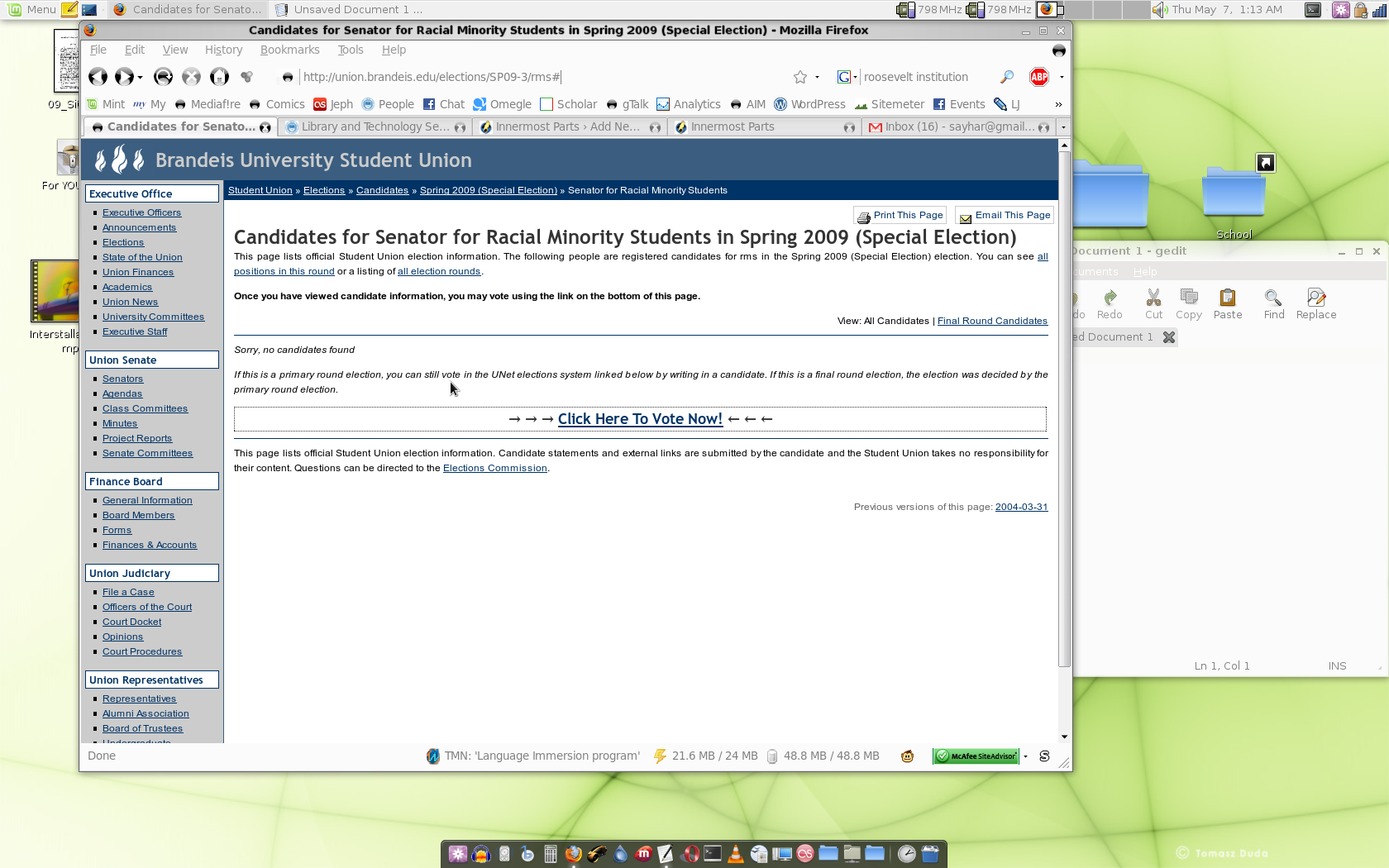
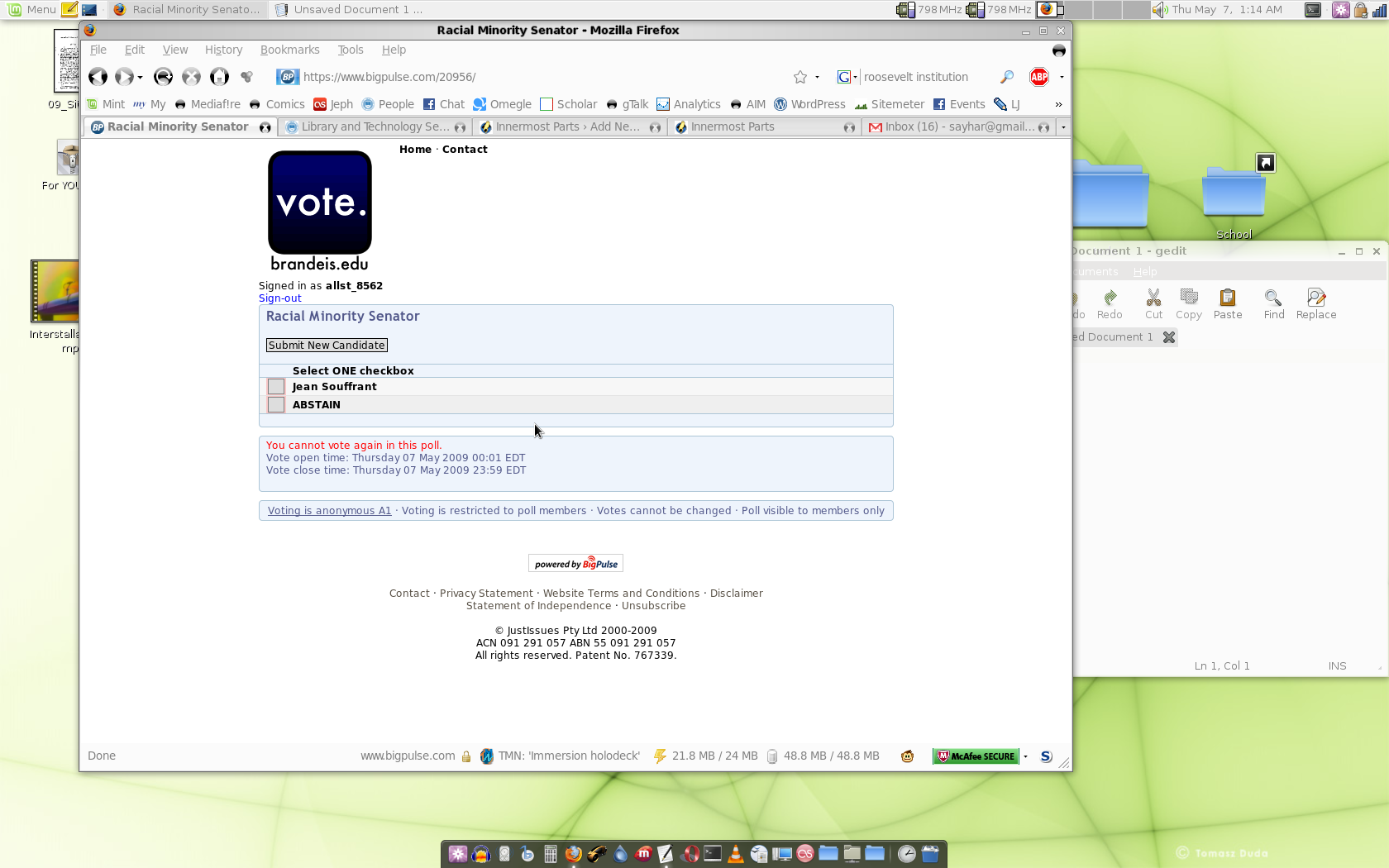
Except (because no Union election can ever run smoothly) you can observe that no candidates are listed as officially running on the Union site. Once you get into the bigpulse voting software, however, Jean Souffrant is listed as an official candidate.

union-page

bigpulseObserve how the union has some confusion over who exactly is running for the position. Furthermore, there hasn’t been a student-wide email informing people about the election.

Not that this is a big deal. Unless there’s a write-in candidate to challenge Mr. Souffrant, the outcome of the election doesn’t seem to have changed.

Still. Why do union elections always suffer some sort of error?

Guns at Brandeis — A Year Later

About a week and a half ago, Brandeis saw something that had never happened before.  Several Public Safety officers responded to an on-campus incident by drawing their firearms, the first time that has happened since the guns were issued last June.  After the fierce debates over arming campus police last year, there’s been surprisingly little said about the decision now that it has gone into effect, so I think this incident is as good an excuse as any to revisit the initial controversy and take stock of what we’ve learned since.

The incident in question occurred Friday, April 24th.  The Hoot described the circumstances:

According to [Director of Public Safety Ed] Callahan, a responding public safety officer had been looking at footage from a closed circuit camera placed in the quad after receiving a call about marijuana use near Shapiro residence hall when a scan of the quad revealed a huddle of male students by Deroy residence hall holding what appeared to be a small caliber firearm.

The officer watching the live feed waited until the group of boys pulled the back slide of the fire arm back and forth—something that could not be done on a toy gun— and then put the gun in a paper bag before responding to the quad with armed officers….

Once on the scene, the officers drew their semiautomatic handguns from their holsters in order to secure the scene before ordering the three male students to put their hands in the air and to get on the ground…

Unlike most others on Innermost Parts, I was not involved in Students Opposed to the Decision to Arm last year, and I never had a problem with the idea of arming our officers.  It was clear to me that Public Safety considered access to a firearm a necessary precaution in their job and that officers felt perpetually vulnerable without one.  I understand and respect the concern that many students had about changing the culture on campus by introducing weapons.  However, I’ve never had any reason to doubt the intentions and competence of Public Safety, and I felt that all necessary precautions were being taken to make wielding firearms as uncommon and controlled as possible.  If I do not trust an officer of the law with a gun, then I don’t trust him to be a police officer at all, and I never felt that this level has been crossed at Brandeis.

This incident only serves to strengthen my conviction that arming Public Safety was the right decision to make.  Because it took so long for firearms to be drawn, we can see that it is only under the most critical of circumstances that they will be employed.  In fact, the only reason they were drawn at all was in response to an illegal weapon, and though the student’s gun turned out to be a relatively harmless pellet gun, the threat of bodily harm to the officers was still all too real.  In a broader sense, I don’t feel that guns have become the uncomfortable presence that many feared they would be, and I’ve never heard anyone suggest otherwise.  The idea of students possessing illegal firearms is far more troubling to me, and we now know this to be a reality (the Hoot story mentions that this wasn’t the first firearm apprehended this year).  There is comfort to be found in the knowledge that these situations can be dealt with safely.

Still, I feel that SODA’s efforts last year were noble, and there have been tangible and positive effects coming from the outcry that students raised.  The increased emphasis on student rights we’ve seen this year comes directly from the concerns that were shared last year.  The formation of the Office of Student Rights and Advocacy, the distribution of “Know Your Rights” magnets, and the support and progress towards a Student Bill of Rights all owe something to the vocal presence of SODA.  The Senate Social Justice Committee put on some great events like the Search and Seizure Forum under the leadership of SODA member Lev Hirschhorn, and Innermost Parts itself might never have been founded had it not been for the reaction against arming.

Ultimately, the anti-arming movement was successful in some respects, even if they weren’t the goals it initially had in mind.  Healthy debate is never a bad thing, and the fact that students showed how much this issue meant to them could have something to do with the transparency over our one firearm incident.  But we should all be glad that a threatening situation was safely diffused, and it’s important to note that this is exactly what arming the police was for.

Thoughts on the Rose Committee’s Interim Report

“BRANDEIS IS NOT CLOSING THE ROSE AND SELLING ALL THE ARTWORK.” Words and italics from them, bold and caps from yours truly.  If you’re going to take anything from the interim report of the Future of the Rose Committee, make it that.  We’ve sat and listened as the Rose first was closed, then open for the semester, then for part of the summer, then the whole summer, then open indefinitely.  Finally, we have an absolutely definitive statement from a body that’s spent lots of time researching this very issue that the Rose is not going anywhere, and, in fact, that we’re bound by donor agreements to keep the Rose Art Museum open by that very name.

The report, which was released to the entire Brandeis community last Thursday, is just a preliminary document detailing the progress the committee has made towards compiling its final report, which will be released in early fall.  I recommend reading the whole thing, as there’s a lot to chew over (everyone with a Brandeis e-mail address should have received it on Thursday; if you didn’t get it/already deleted it, we’ll have it uploaded as soon as I can figure out how to use our media library you can find it here in PDF form).  The following are just some quick thoughts on points I found particularly important:

  • Legally, there is absolutely no reason why we can’t continue to operate a public museum even after sales of art work.  Why was there so much misinformation about this?  Why did I hear so often that keeping the Rose open was impossible if we sold even part of the collection?  Why didn’t the University immediately correct these statements?  They must have done some research into the legal issues involved, right?  It’s a testament to utter failure of the message control over the Rose that not only was our course of action completely incorrect as initially announced, but that we couldn’t even get simple, critical facts like this correct.
  • That being said, selling art for any reason other than to purchase other art is a huge taboo in the museum and art communities.  Of course, we already knew this.  However, now that we have clarified that the Rose itself isn’t going anywhere, it’s time for the art world to meet Brandeis halfway here.  Our message now is actually refreshingly frank and fair.  The facts are simple: the University as a whole is more important than the Rose; if the University fails, the Rose goes down with it; we are doing everything we possibly can to avoid selling any artwork; but if worst comes to worst, we will do as we must to maintain the Brandeis we know and love.  If the members of art community tries to dispute any of this, they are leaving their area of expertise, which is art, and trying to outdo university administrators at university administration.  If they instead approach us as allies with a vested interest in how we survive our time of crisis, we can come together to find the least damaging and most acceptable solution, and the lessons we learn and the bonds we form will keep a situation like this from ever occurring again.  Until the dogma of “art sales are bad, period” is abandoned, we are losing our only chance to make the best of this situation.
  • The Future of the Rose Committee is remaining neutral on the core matter of selling art to raise funds, and I couldn’t applaud them any more for it.  Their stance will disappoint some people.  However, they are not avoiding this important debate; they are merely ensuring that it occurs in its proper setting, among the entire Brandeis community.  By ceding the chance to become partisans with the platform they were given, they are strengthening their position as unbiased researchers,  and the debate which will occur will be more informed for it.

Overall, the report is a great summary of what we know so far, and it will be a valuable tool to counter the negative propaganda which is still hounding us.  My personal thumbs up goes out to the Committee, and I look forward to reading the final report.

What Bill Ayers Tells Us about Student Autonomy

Before my title deceives you, I unfortunately missed Bill Ayers’ lecture on Thursday, and I have no idea what he talked about.  He might have brought up the idea of student autonomy; chances are he didn’t.

The event itself, however, sure told us a lot about the freedom we enjoy as Brandeis students — and it showed us that our administrators are dedicated to keeping it that way.

Imagine you’re Jehuda Reinharz.  Your university has taken a series of PR hits in recent months, some of them undeserved, and is now fighting an image of financial insolvency and betrayal of key donors and the art community as a whole.  You are facing a decreased applicant pool while needing to accept more students than ever.  It is absolutely critical that you do as little as possible to alienate your recently accepted students while they decide if they want to spend the four most critical years of their lives paying your tuition.

In the middle of all this, a group of students wants to invite a controversial speaker to your campus.  Not just any controversial speaker.  This is a man who public opinion has labeled an unrepentant murderer and terrorist.  A man whose name was recently plastered over the national news in discussion of whether his acquaintance alone should disqualify someone from assuming the United States Presidency. You know that his speaking at your school will cause a minor uproar.  You’ve seen it happen at a nearby university of similar reputation, to the point where they canceled his appearance.

Predictably, the comment pages of the local newspapers soon fill with vitriol.  The worst stereotypes of your university are dragged up and rehashed over and over.  One website even publishes the names, phone numbers, and e-mail addresses of you and your fellow high-level administrators, presumably causing your inbox to fill with angry, ignorant screeds.

Would you still allow the event to continue?

The administration really got in the students’ corner on this one and proved their commitment to allowing us autonomy and educational freedom.  Their public comments struck exactly the right tone — that Brandeis does not endorse Ayers’ actions, but that they believe in giving us access to a wide range of viewpoints, and, implicitly, that they will not interfere with our ability to plan our own events through established channels.  Even those who protested Ayers must realize the courage and respect for students that underlaid the administration’s singing off on the event.

It’s possible that Ayers’ appearance has already discouraged some prospective students from enrolling at Brandeis.  It’s also possible that those who take offfense to Ayers would never have considered a school like Brandeis in the first place, and that our defense of principle over petty criticism will impress the prospectives enough to work in our favor.  Either way, the administration deserves a round of applause for this one.

Why not send Jehuda an e-mail telling him how you recognize and appreciate the university’s stance towards student autonomy?  I’m sure it’ll be a nice break from the “OMG OMG HES A TERRERIST U PINKO COMMIE SCUM!!!!!!11″ spam that’s sure to be clogging his B-mail.

Andy Hogan, Our New President

Today is Andy Hogan’s second full day on the job as Student Union President, and despite this high-profile position, I feel he’s still something of an unknown quantity to much of the student body, much more so than Jason Gray was last year.  There are several reasons for this: the Presidential race was much less competitive and low-profile than last year’s, Andy has only been a Union officer for one year, and his work has been much more organizational than Jason’s very public advocacy for the Student Bill of Rights.  However, in a very short period of time, Andy has quietly built up a stellar Union resume.  Last fall, he handily won the North Quad Senate seat despite running as a sophomore in a mostly freshman quad.  In just one semester of work, he impressed Jason Gray enough to be named Director of Community Advocacy.  And last month, he won the Union Presidency by over 350 votes.  His talents and character have already changed the Brandeis community for the better and are quickly gaining wide recognition; however, for those who still don’t really know Andy or who would like to know him better, I’d like to give a quick introduction to our new Union President.

I should start by saying that I’m far from an unbiased source.  Though I felt that being off campus made it appropriate for me to refrain from public comment on the spring elections, I was personally very happy to see Andy win.  But my relationship with him is much deeper than mere Union politics.  Andy has been one of my best friends since our first few weeks at Brandeis.  We joined (and subsequently left) TRON together, played together on countless intramural sports teams, served together on the Squash club E-Board, served together on the Union Senate, roomed next to one another, shared music, been repeatedly mistaken for brothers, and generally shared some of the best times I’ve had at Brandeis.  He was my campaign manager during my run for the Vice Presidency, and I still credit my victory more to him than to anyone else.  So yeah, I kinda like the guy.  But I also know him very well, and looking as objectively as possible, I can say that I think he’ll make an excellent leader for the Student Union.

Innermost Parts is an activist community, so it’s of particular importance to us that Andy has established himself as a leader on activist issues in the Student Union.  One of his first major projects was planning the Combating Hate Fundraiser, which broke all attendance expectations and raised over $2,000 for a black church that was burned in protest of Barack Obama’s victory.  He followed that with another successful fundraiser for rape victims in the Rwandan genocide.  On a more Brandeisian level, he played a huge role in launching and running the Clubs in Service program, and he helped dorm-storm with Student for Environment Action to raise awareness of water-bottle reduction.  He’s the only Union officer I’ve seen to devote a page of his campaign website just to explaining his views on the importance of social justice at Brandeis.  Clearly, he intends to make these issues a focal point of the Union’s work next year.

Andy is particularly dedicated to the Union government’s role as an advocacy body, and one of his primary focuses is on bringing the Union’s work to every student.  In this way, I see his mentality as a natural successor to Jason’s core value of increased student involvement, both within the Union and in the entire Brandeis community.  He was one of the first senators to join the new Senate Outreach Committee, and he was one of its most active members, drafting the Stall Street Journal and planning events targeted at spreading awareness of the Union’s work to freshmen.  Critically, he views outreach as a tool for generating student feedback, not as a self-promotion gimmick.  He gave us the cell phone amplifier in Usdan in response to numerous student complaints, working successfully with administrators to improve student life.

His plans for next year come naturally from these concerns, and I’m very excited to see some of them implemented.  I’m particularly impressed by his ideas in the long-overdue area of club collaboration reform, which will create an online system for booking spaces and discussing co-sponsorship, making event planning quicker and less expensive.  Andy also wants to improve methods for instantaneous student feedback on Union projects.  Discussion boards have been very effective at generating diverse ideas from the whole community for the CARS subcommittees, and there is no reason why they cannot be used on a Union level as well.  He remains committed to starting and expanding environmentally-friendly projects like Deis Bikes, and his planned social justice identity forums will inspire discussion on the many ways this pillar of Brandeis is interpreted in the community, ultimately creating connections for socially responsible programs where none currently exist.

This past year has been unprecedented in the scope and importance of the Union’s successes, largely because of Andy’s contributions.  I expect Andy Hogan’s leadership to make next year just as productive as this one has been.

Leeyat Slyper Sworn In

For those of you who follow such things, the Elections Commission changed its mind on who won the Union Judiciary elections, and Leeyat Slyper was sworn in as the fifth Justice during Wednesday’s inaugurations.  Regardless of what you think about the interpretation of the elections rules, I can’t see anyone complaining too much about this; she clearly wanted the position when no one else did.  Congratulations, Leeyat! (and Justin, Matt, Judah, and Neda!  and everyone else who was sworn in on Wednesday!).